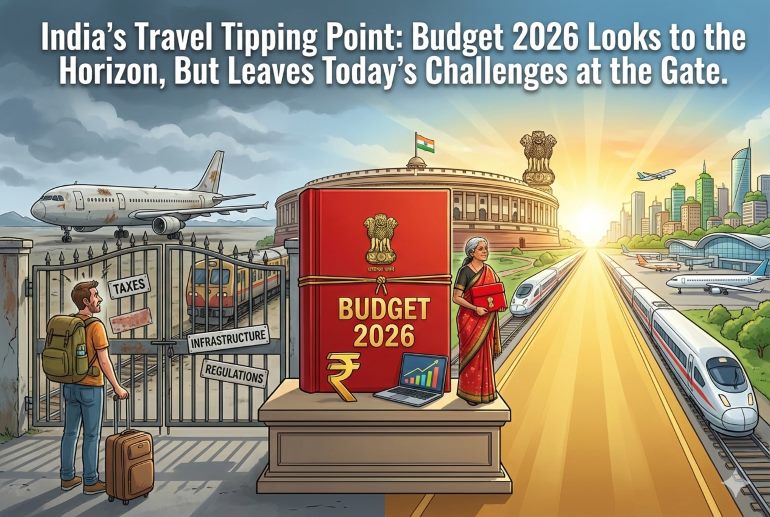
The Union Budget 2026 was poised to be a defining moment for India’s tourism sector—an industry on the cusp of a powerful resurgence. What emerged was not a short-term stimulus, but a sweeping blueprint for 2047. While it charts an ambitious course for the future, it leaves key financial roadblocks firmly in the present.
Building the Future: A Vision of Connectivity and Experience
The government’s long-game strategy is clear and multi-faceted. It moves beyond mere promotion to fundamentally reshape the country’s travel infrastructure.
Connecting the Dots: The massive allocation for new railway corridors and airports in tier-2 and tier-3 cities is perhaps the most transformative element. This isn’t just about convenience; it’s a strategic move to decentralize tourism, reduce pressure on saturated hotspots, and unleash the economic potential of India’s vast hinterland.
Curating Destinations: The plan to develop “iconic tourist centres” and specifically target high-yield segments like spiritual tourism, island development, and adventure circuits marks a shift from volume to value. It’s an acknowledgment that the future traveler seeks depth, authenticity, and curated experiences.
Investing in Human Capital: The upgrade of the National Council for Hotel Management into a National Institute of Hospitality, coupled with structured schemes to skill thousands of tourist guides, tackles the industry’s most persistent post-pandemic challenge: a talent shortage. This focus on professionalism aims to elevate the entire visitor experience.
“The Budget 2026 focus on adventure tourism, Buddhist circuits, and a digital tourism framework highlights the importance of responsible, experience-led growth that protects the very destinations travellers seek.” – Anil Chadha, ITC Hotels
The Unmet Demands: The Industry’s Fiscal Wishlist Goes Unanswered
For all its future-facing promise, the budget’s silence on immediate fiscal relief was deafening to hoteliers, restaurateurs, and tour operators grappling with day-to-day operational costs.
The Financing Chasm: The most significant disappointment was the omission of infrastructure status for the entire hospitality sector. This status is not a mere label; it is a passport to long-term, low-cost capital essential for building new hotels in emerging destinations. Without it, expansion remains prohibitively expensive.
The Tax Squeeze: Critical taxation issues were sidelined. The industry’s plea for the restoration of Input Tax Credit (ITC) for the restaurant sector—a move crucial for improving razor-thin margins and encouraging formalization—was ignored. Similarly, hoped-for “Green Tax Benefits” to incentivize sustainable investments in hotels found no mention.
The Operational Maze: For smaller resorts and ecologically-sensitive properties, the budget offered no relief on the ground. Calls for streamlined, single-window clearances for sustainable projects were left unaddressed, leaving a tangled web of licenses and approvals in place.
“Our long-standing ask to grant comprehensive infrastructure status to the sector continues to remain a distant dream.” – Shwetank Singh, Chalet Hotels
Clear Wins: Direct Benefits for Travelers
Amidst the strategic plans and missed opportunities, two direct wins emerged for the everyday traveler:
- Cheaper International Holidays: The rationalization of Tax Collected at Source (TCS) on overseas tour packages to 2% is a tangible relief. It reduces the upfront cash outflow for travelers, making international trip planning slightly less burdensome.
- The Rise of Medical Value Travel: The announcement of five new regional medical tourism hubs integrating modern healthcare with AYUSH systems positions India as a holistic wellness destination, offering a new compelling reason for inbound travel.
The Verdict: A Map for Tomorrow, No Fuel for Today
Budget 2026 is, unequivocally, a visionary document. It successfully frames tourism as a central pillar of India’s economic future and lays a strong foundation through connectivity, destination development, and skilling.
However, vision requires execution, and execution requires capital and conducive policy. By sidestepping the sector’s urgent calls for financial restructuring and tax relief, the government has provided a detailed map to a promising horizon but withheld the fuel needed for the industry to accelerate its journey there. The path to becoming a global tourism powerhouse is now charted, but the immediate climb just got a little steeper.
For continued analysis on how these policies translate into your travel experiences, follow TravellersAtlas.com.