For decades, the global imagination has painted Ladakh in magnificent, monochromatic strokes: a stark, high-altitude cold desert dominated by rugged ochre ridges, sweeping sand dunes, and brilliant sapphire skies. Known affectionately as the “Land of High Passes,” this trans-Himalayan frontier has traditionally drawn adventurers seeking the raw, untamed solitude of a pristine, barren earth.
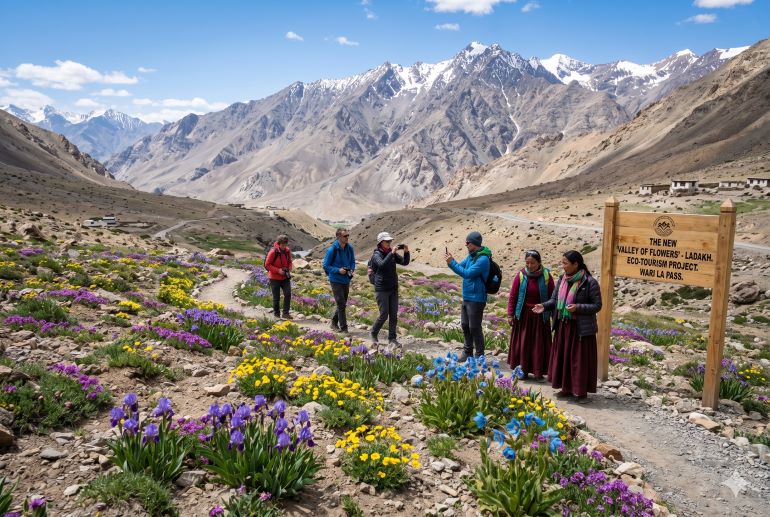
However, a transformative visual and ecological shift is underway. In an ambitious bid to diversify its tourism landscape while addressing environmental sustainability, the Ladakh administration launched a sweeping initiative to develop twin high-altitude “Valleys of Flowers.” Spearheaded by Lieutenant Governor Vinai Kumar Saxena, this project aims to infuse vibrant seasonal color into the arid terrain, creating an arresting juxtaposition of delicate blossoms against sun-bleached mountains.
Focused primarily on two distinct geographical corridors—Choglamsar and the formidable Wari La pass—the initiative represents one of the region’s most fascinating experiments in ecological engineering and sustainable destination management. Set to reach its peak summer bloom by late June, the project invites travelers to witness a newly emerging botanical wonderland at the roof of the world.

The Twin Sites: From Riverbanks to Mountain Passes
Rather than attempting to blanket the entire high desert, the project strategically targets two distinct micro-climates, each offering a unique interface for travelers exploring the Union Territory.
1. Choglamsar: The Cultural Oasis
Situated along the life-giving banks of the Indus River, just a short drive from the bustling commercial center of Leh, Choglamsar has long been recognized as a serene residential and educational hub. Steeped in rich Tibetan heritage—home to the iconic SOS Tibetan Children’s Village and close to ancient rock carvings—Choglamsar offers a more tranquil, grounded alternative to the main city.
By integrating extensive floral corridors along its thoroughfares and public spaces, the administration is turning Choglamsar into an accessible green gateway. Travelers driving outward toward historical monasteries like Thiksey and Hemis are now greeted by curated stretches of resilient flora, creating an inviting, pedestrian-friendly environment that encourages visitors to slow down and engage with local communities.
2. Wari La: The High-Altitude Frontier
If Choglamsar represents riverside accessibility, Wari La embodies raw alpine grandeur. Scaling over 17,000 feet, Wari La is a remote, challenging mountain pass that connects the main Indus Valley to the enchanting expanses of the Nubra Valley. Traversing this route has historically been a test of endurance through sheer, rock-strewn switchbacks.
By introducing seasonal patches of hardy alpine flora along the lower and mid-level ascents of the pass, the project aims to transform a demanding transit route into an immersive scenic journey. The visual impact of vibrant floral beds thriving in thin air offers photographers and trekkers a striking new element, shifting the narrative of Wari La from a mere shortcut to a premier eco-tourism destination in its own right.
Botanical Resilience: Greening the Cold Desert
Cultivating life in a region characterized by sub-zero winters, negligible rainfall, intense ultraviolet radiation, and nutrient-poor soil requires precise scientific intervention. The “Valley of Flowers” initiative is not a conventional landscaping effort; it is a carefully calibrated exercise in high-altitude botany.
Selecting the Flora
Developed in close consultation with leading horticulturists, environmental scientists, and native botanists, the plant selection criteria prioritize absolute hardiness, extreme frost tolerance, and minimal water consumption. The goal is to establish a self-sustaining ecosystem rather than a resource-intensive artificial garden.
The plantation architecture relies on a multi-tiered approach:
- Native Alpine Integration: At the core of the project lies the propagation of indigenous high-altitude shrubs and wildflowers naturally adapted to the trans-Himalayan ecosystem. Enhancing these native patches ensures that local pollinators, such as bees and rare mountain butterflies, thrive without disrupting natural ecological succession.
- Resilient Green Cover: To build structural windbreaks and prevent topsoil erosion, resilient tree varieties including Blue Pine, Deodar, and Cypress are being introduced in sheltered pockets.
- Seasonal Aesthetic Blooms: For immediate bursts of visual allure during the short summer tourism window, regional nurseries have successfully conditioned hardy ornamental varieties—such as specialized strains of Marigolds, Salvias, Petunias, and native Champa. These are deployed in localized beautification zones to frame public pathways and scenic overlooks.
Catalyzing Sustainable Tourism and Local Economies
Beyond visual aesthetics, the underlying objective of the project is socio-economic enrichment. As Ladakh’s popularity has surged, visitor footfall has heavily concentrated around a few iconic sites—primarily Leh Market, Pangong Lake, and the Nubra sand dunes—leading to localized strain on infrastructure.
The twin floral zones act as strategic dispersal points. By transforming Choglamsar and Wari La into primary attractions, the tourism board encourages travelers to explore alternative circuits. This intentional redirection extends the average visitor’s length of stay and directly distributes economic benefits to suburban and rural homestays, independent cafes, and regional transport cooperatives.
Furthermore, the implementation phase has prioritized a circular local economy. Thousands of specialized earthen pots and planters required for roadside beautification corridors have been commissioned directly from indigenous Ladakhi potters and artisan guilds. Local youth and agricultural workers have also been engaged in the cultivation, planting, and maintenance drives, embedding community ownership into the very roots of the project.
The Delicate Balance: Ecology vs. Expansion
Any large-scale intervention in a highly fragile ecosystem naturally invites crucial dialogue regarding long-term environmental balance. Ladakh indigenous communities have long practiced harmonious, low-impact living, and local leaders have emphasized that tourism initiatives must respect the desert’s natural cadence.
Recognizing that large-scale plantings require consistent hydration in a water-scarce region, the administration has paired the “Valley of Flowers” rollout with comprehensive water-security measures. Most notably, this includes integration with the parallel “Him Sarovar” project, an ambitious initiative focused on constructing over 50 specialized artificial ponds and reservoirs across the region. These reservoirs are engineered to capture and store seasonal glacier meltwater, ensuring that the enhanced floral zones are irrigated entirely via sustainable runoff rather than depleting vital groundwater or community drinking supplies.
The ultimate target set by the administration is to elevate Ladakh total green cover from its historical baseline of just 0.4 percent to a robust 5 percent over the coming years. When executed with unwavering respect for endemic biodiversity, this greening effort promises to yield healthier micro-climates, improved soil retention, and cleaner air for future generations.
Treading Lightly in a High-Altitude Eden
As the high summer season commences, travelers arriving in Ladakh will find a landscape gently redefining its boundaries. The emergence of these high-altitude floral zones serves as a powerful testament to nature’s adaptability and human ingenuity.
For the mindful wanderer, the new Valleys of Flowers offer an invitation to experience Ladakh through a fresh lens. Whether marveling at a brilliant cluster of blossoms framing the Indus River at Choglamsar or pausing to capture the delicate petals braving the crisp winds of Wari La, visitors are reminded of the profound beauty that emerges when resilience meets care. As you pack your bags for this frontier, let the blooming desert be a reminder to travel responsibly, leaving no trace behind but footsteps in this extraordinary mountain garden.